Polymarket bans in Europe: which countries block it, and what you actually risk
Czechia put Polymarket on its blocked list on Monday, Italy did the same on 10 July, Slovakia in June. But a national block and the platform's own country ban are two different walls — and in most of Europe only one of them is up.
 RewardHunter Who I am → 15 Jul 2026 · 4 min · 10 sources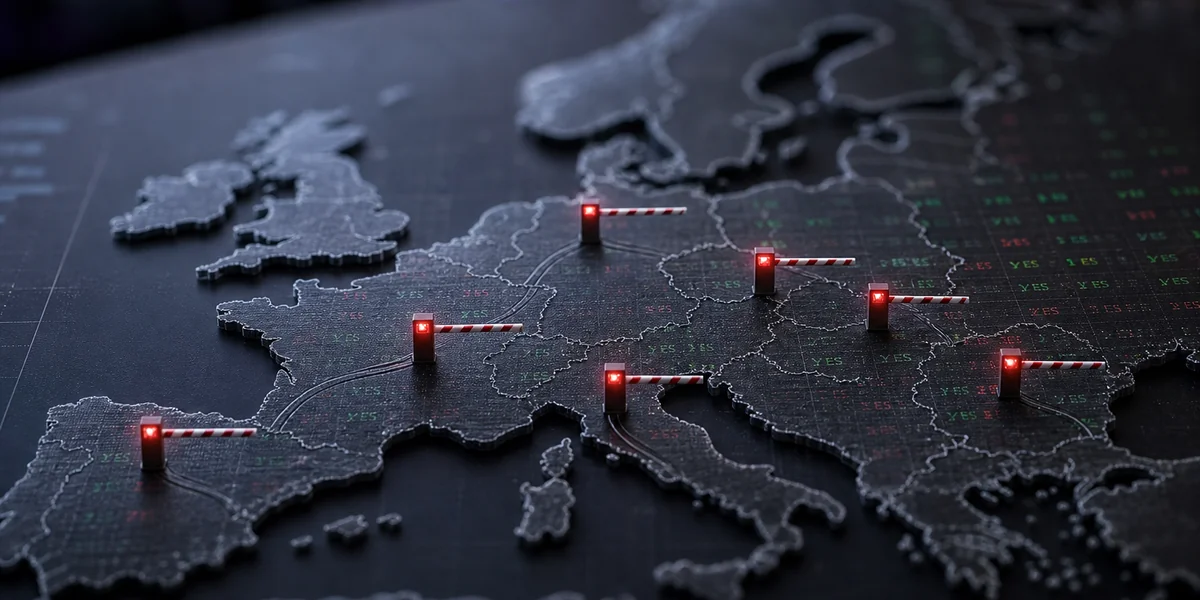
If you are reading this in the UK, the answer is short and it has nothing to do with any British regulator: Polymarket does not accept you. The United Kingdom sits on the platform's own published list of restricted countries, alongside Germany, France, Italy, Poland and Belgium. Nobody had to ban it here. It bans us.
That list is the thing almost every write-up of the past month has missed. There are two separate walls around a prediction market, and they do not line up:
- The state's wall. Your country orders internet providers to block the website. The platform may not even notice.
- The platform's wall. The company itself refuses users from your country, checks where you are, and turns you away at the door.
In the UK only the second wall is up. In Czechia, right now, only the first one is — and it isn't finished.
What a "prediction market" is, and why gambling regulators care
A prediction market lets you buy a yes/no contract on something that hasn't happened yet — an election result, a football match, an interest-rate decision. If you're right, the contract pays out a fixed amount; if you're wrong, it pays nothing. Polymarket settles in crypto; its US rival Kalshi is a regulated exchange in the United States.
The platforms describe this as trading. European gambling regulators look at the same product and see a bet on an uncertain event, taken by an operator with no local licence.
On 17 June 2026, nine of them said so together. The gambling authorities of Belgium, France, Germany, Italy, the Netherlands, Poland, Portugal, Spain and Switzerland issued a joint statement on prediction markets, opening with the fact that the Men's World Cup had just started. They wrote that these platforms carry "several addictive features", that they involve "serious risks of illegality, fund blocking, fraud through insider information, and financial volatility", and — the operative line — that the nine would "act, where necessary, against prediction markets platforms that fail to comply with our local regulations".
They named no company. They did address football directly, reminding "sports federations, leagues and teams, to ensure that these platforms are lawful within their jurisdiction before entering into major partnerships with them" — a sentence written three months after Polymarket became the main shirt sponsor of Serie A club Lazio, in a multi-year deal Italian press put at around $22 million.
Then the blocks came. Slovakia on 22 June. Italy on 10 July. Czechia on 13 July. All three within a month of the joint statement.
Where things actually stand
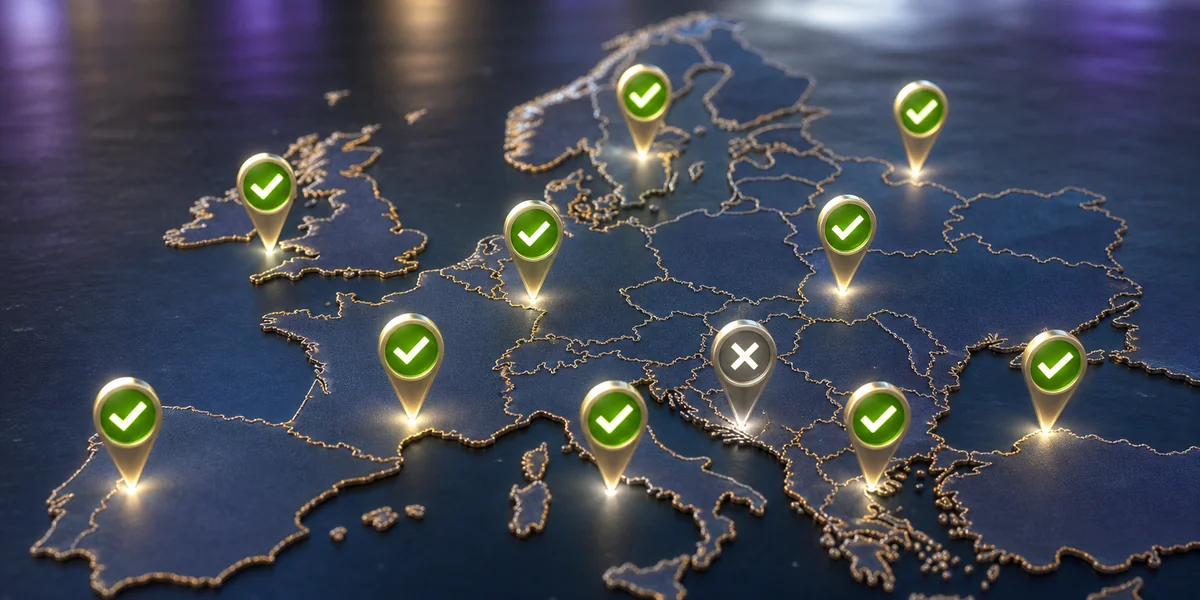
| Country | Blocked by the state? | Does Polymarket block you? | What users risk |
|---|---|---|---|
| United Kingdom | No | Yes — on its own list | — |
| Germany | No — the GGL warned, it didn't block | Yes — hold to resolution, then withdraw | § 285 StGB: up to 6 months' prison or 180 daily rates |
| France | No order — it self-blocked | Yes | Nothing stated by the ANJ |
| Italy | Yes, ADM, 10 Jul 2026 (Kalshi too) | Yes — view only, no trading | — |
| Poland | Yes, 8 Jan 2025 (Kalshi 14 Apr 2025) | Yes, but also listed close-only | Art. 109 KKS: up to 120 daily rates, plus 100% of winnings |
| Czechia | Yes, 13 Jul 2026 — ISPs have 15 days | No | — |
| Slovakia | Yes, 22 Jun 2026 | No | — |
| Spain | Precautionary only, 25 May 2026 (Kalshi too) | No | Nothing stated by the DGOJ |
| Romania | Yes, ONJN, 29 Oct 2025 — court upheld Apr 2026 | No | Fine of 5,000–10,000 lei |
| Hungary | Yes, SZTFH, 19 Jan 2026 — interim, pending a final ruling | No | — |
| Thailand | — | Yes, but also listed close-only | — |
The platform's own page is worth a squint. It announces "the following 33 countries are completely restricted" and then lists 35. Four of those 35 — Poland, Thailand, Singapore and Taiwan — turn up again further down the same page under "close-only", meaning you may close an existing position but not open one. Both things cannot be true, and the difference decides whether a Polish user's money is stuck or retrievable. Germany gets a third treatment again: positions must be held to resolution, after which funds can be withdrawn without restriction.
Czechia is not blocked yet. The Ministry of Finance entered polymarket.com in the register on Monday under § 84a(2)(a) of the gambling act. Providers then have 15 days to actually block it — so realistically around 28 July. Today the site opens. Kalshi is not on the Czech list at all.
France never banned it. This is stated backwards nearly everywhere. The ANJ's own notice says the operator, Adventure One QSS Inc., "a décidé de mettre en place un géoblocage" — decided to put geoblocking in place, after talks. Polymarket walked out of France; it was not thrown out.
Spain's block is provisional. The order of 25 May 2026 is a medida cautelar — a precautionary measure while a sanctioning file runs, which the ministry expects to take three to four months. It covers both Polymarket and Kalshi. Nothing is final.
The part that affects you, not the company
In three countries the law reaches the user, not just the company:
- Poland — Article 109 of the fiscal penal code punishes taking part in an unlicensed game with a fine of up to 120 daily rates, and a separate administrative penalty of 100% of your winnings, with your stake not deducted. You can end up taxed on a gross figure you never kept.
- Germany — § 285 StGB makes participating in unlawful gambling a criminal offence: up to six months' imprisonment or a fine. It requires intent, which is doing a lot of work here.
- Romania — taking part from Romanian territory in unlicensed online gambling is a contravention under Emergency Ordinance 77/2009, reported to draw a fine of 5,000 to 10,000 lei regardless of how much you staked or won. The ONJN blacklisted Polymarket on 29 October 2025 after transaction volume on Romania's presidential election passed $600 million. Polymarket asked a court to suspend the decision; in April 2026 the court refused, and its challenge on the merits has not been heard.
Spain's and France's notices say nothing about penalising users at all.
After the Romanian court refused Polymarket's suspension request, the ONJN's president, Vlad-Cristian Soare, said the point of the case was "preventing a dangerous loophole: redefining betting under the apparently harmless name of a 'prediction platform'" — our rendering of his Romanian, as reported by Financial Intelligence.
What ESMA did not say
On 3 July the EU's securities regulator, ESMA, published a statement on event contracts, and the finance press reported it as Europe moving to block prediction markets. Read it and that framing collapses. It says, in its own words: "Not all event contracts are financial instruments." Only contracts on financial underlyings — securities, currencies, rates, commodities, indices — qualify. It names no company, not Polymarket, not Kalshi. It creates no new law; it is a reminder about binary-option rules that already existed.
An election or a football match is not a security. So the platforms' flagship markets fall outside ESMA's remit entirely, which is why ESMA's own footnote points at national gambling law instead. Every real block in the table above was made by a gambling regulator.
What I'd actually watch
Slovakia went further than anyone. Its register doesn't just name the offshore operator, Adventure One QSS, Inc. — it names Polymarket's US arm alongside it, "QCX LLC d/b/a Polymarket US". And the same day, under the same provision, it blocked a German bank account. The register doesn't say whose that account is; it was the only other entry filed that day under that limb, while the four other sites blocked on 22 June went in under a different one. Polymarket still doesn't list Slovakia among its restricted countries.
What I'd watch next: whether Czechia and Slovakia end up on Polymarket's own list.
This is reporting on what regulators and platforms have published, not legal advice. If you are unsure where you stand in your country, ask someone qualified there.
Sources
- Polymarket — Help Centre, 'Geographic Restrictions' (primary: the platform's own list of restricted countries)
- Joint statement by nine European gambling regulators on prediction markets, 17 June 2026 (published by Germany's GGL)
- Ministerstvo financí ČR — Seznam nepovolených internetových her (polymarket.com entered 13 July 2026) cs
- Úrad pre reguláciu hazardných hier (SK) — zoznam zakázaných ponúk (polymarket.com entered 22 June 2026) sk
- Ministerstwo Finansów (PL) — Rejestr domen zakazanych (polymarket.com 8 Jan 2025, kalshi.com 14 Apr 2025) pl
- Agenzia delle Dogane e dei Monopoli (IT) — elenco siti inibiti, giochi (polymarket.com and kalshi.com, list updated 10 July 2026) it
- ANJ (FR) — 'Suite à l'intervention de l'ANJ, le site POLYMARKET ne propose plus ses services sur le territoire français', 29 Nov 2024 fr
- Ministerio de Derechos Sociales, Consumo y Agenda 2030 (ES) — precautionary blocking order against Polymarket and Kalshi, 25 May 2026
- ESMA — Public Statement on the application of national product intervention measures on binary options to event contracts, 3 July 2026 (ESMA35-243228190-8148)
- § 285 StGB (DE) — Beteiligung am unerlaubten Glücksspiel de
If a guide saved you time, you can buy me a coffee — no strings.
Buy me a coffeeComments
Comments appear after approval.