
How to buy Japanese stocks from the UK and Europe in 2026 — Tokyo Stock Exchange via eToro
Three years ago, 5% of retail investors named Japan as the market most likely to deliver the strongest long-term returns. Today that figure is 14%, and as of 13 April 2026 eToro's UK and European clients can finally act on it directly. The launch covers the Nikkei 225 on the Tokyo Stock Exchange — Toyota 7203, Sony 6758, Nintendo 7974, Keyence 6861 and the rest — with the broader TSE arriving in batches. This guide explains how to buy and invest in Japanese stocks from outside Japan: what's available, what it costs, where the friction is, and the steps to place the first order.
eToro is a multi-asset investment platform. The value of your investments may go up or down. Your capital is at risk. Other fees apply.
On this page
- 01 Why investing in Japanese stocks was a hassle
- 02 What changed on 13 April 2026
- 03 How to invest in Japanese stocks: what's on the menu
- 04 JapanEconomy Smart Portfolio
- 05 Why ADRs aren't a substitute
- 06 Why invest in the Japanese stock market in 2026?
- 07 Three things to check first
- 08 How to buy Japanese stocks step-by-step (TSE on eToro)
- 09 Costs and fees
- 10 How to trade Japanese stocks safely — full risk list
- 11 FAQ
Why investing in Japanese stocks was a hassle until 2026
For most UK and European retail investors, "how can I buy Japanese stocks?" had no clean answer. Here's what brokers actually offered going into 2026:
| Broker | Tokyo Stock Exchange? | Notes |
|---|---|---|
| Trading 212 | ❌ No | US/EU + crypto only — no TSE listings |
| Trade Republic | ❌ No | EU markets + ADRs only |
| Revolut | ⚠️ ADRs only | Sony, Toyota US-listed shadows; no native TSE shares |
| XTB | ⚠️ ADRs only | US-listed Japanese ADRs only; no native TSE access |
| DEGIRO | ✅ Yes | €5 + 0.05% per trade + €2.50/yr exchange connectivity fee |
| Interactive Brokers | ✅ Yes | Best execution, but onboarding hostile to retail beginners |
| Saxo Bank | ✅ Yes | High minimums, premium pricing |
| eToro | ✅ Yes — new | Direct TSE access from 13 April 2026, no JPY account needed |
Anyone wanting Japan exposure ended up with one of two compromises: US-listed ADRs (a short menu of dual-listed mega-caps with decent liquidity), or the friction of opening a DEGIRO / Interactive Brokers / Saxo account. Mid-caps like Nintendo (7974) or Keyence (6861) sometimes had OTC ADRs, but most UK and European retail apps don't carry OTC instruments at all — so for many readers, the "best" option was no option.
What changed on 13 April 2026
eToro turned on direct Japan Exchange Group (JPX) access for UK and European clients. Three pieces of the launch are worth calling out:
- Nikkei 225 live, full TSE in batches. The first wave covers the Nikkei 225 — 225 large-cap Japanese names selected across sectors. Wider TSE Prime / Standard / Growth segments are being rolled out in subsequent batches.
- Real-time market data. Japanese instruments stream live quotes inside the app, replacing the 15-minute-delayed feed that had been standard for many non-US markets on retail platforms.
- One funded account, no JPY wallet. Account base currency stays USD, EUR or GBP — eToro converts to JPY at execution and back to your base on close.
How to invest in Japanese stocks: what's on the menu
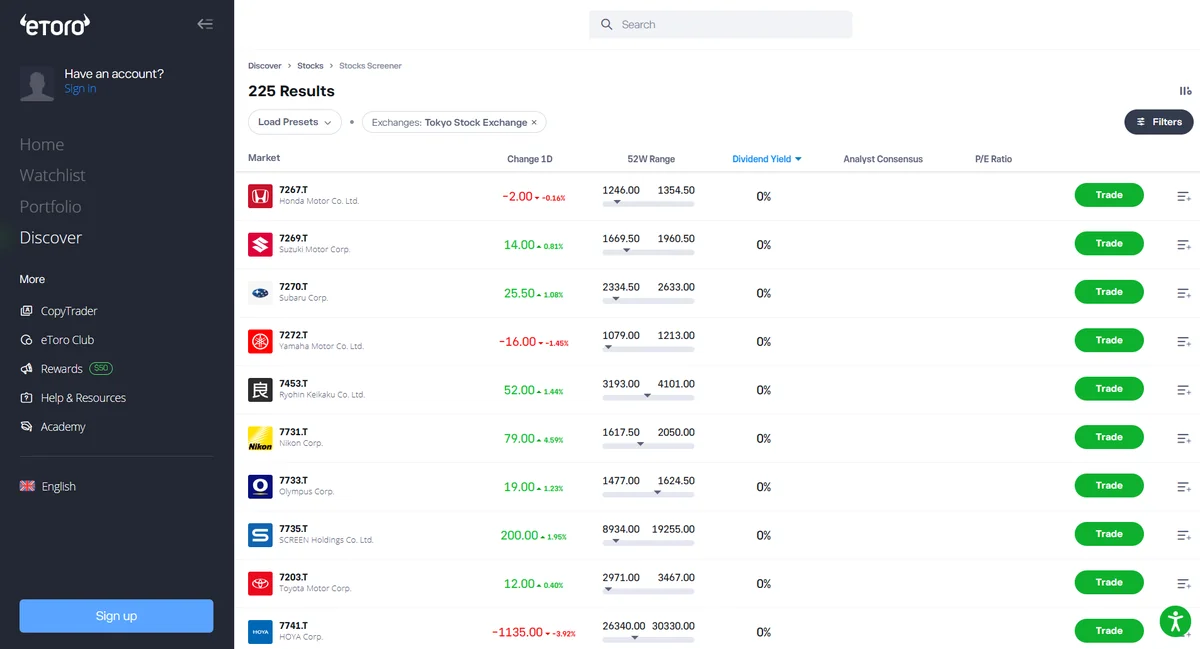
The Nikkei 225 covers the largest, most liquid Japanese names across sectors. Some of the ones international investors usually want first:
Tech & semiconductors
- 6758 Sony — gaming (PS5), image sensors, music, films
- 8035 Tokyo Electron — semiconductor capital equipment
- 6861 Keyence — factory-automation sensors, ~50% operating margins, no debt
- 6723 Renesas — automotive microcontrollers, AI MCUs
Consumer & gaming
- 7203 Toyota — world's largest carmaker, hybrid leadership
- 7974 Nintendo — Switch 2 launching FY2026, IP-rich (Mario, Zelda, Pokémon)
- 9983 Fast Retailing — Uniqlo parent, Asia retail giant
Financials & industrials
- 8306 Mitsubishi UFJ Financial — Japan's largest bank, beneficiary of higher rates
- 9984 SoftBank — Vision Fund + Arm exposure
- 6098 Recruit Holdings — owns Indeed, global HR-tech
Index alternatives
- 1329 iShares Core Nikkei 225 ETF — 225 largest Japanese stocks in one trade
- 1475 iShares Core TOPIX ETF — broader 2,000-stock index, lower fees
The full live list is in eToro's instrument-search — filter the Stocks Screener by Tokyo Stock Exchange:
JapanEconomy Smart Portfolio — for the don't-want-to-pick crowd
eToro launched JapanEconomy at the same time as TSE access — a thematic Smart Portfolio holding around 30 Tokyo-listed names selected on market cap, liquidity and analyst consensus. Roughly half industrials and tech, the rest consumer, communications and financials. You buy it as one position with a single allocation; eToro handles the rebalancing. Useful if you want broad Japan exposure without picking individual tickers, and the main alternative to a Nikkei 225 / TOPIX ETF inside the app.
Why ADRs aren't a clean substitute
Until now, the workaround for "I want Sony / Toyota / Honda" on a typical UK or European retail broker was a US-listed ADR (American Depositary Receipt) — a US-traded certificate backed by the underlying Japanese share, held in custody by a depositary bank. The mechanics are not free:
- Depositary fees. The depositary bank charges roughly 1–3 cents per ADR per dividend distribution (sometimes annually), deducted automatically from your dividend payment.
- Ratio is rarely 1:1. Nintendo's NTDOY ADR represents 1/8 of one TSE-listed share (7974.T), so the ADR price doesn't match the Tokyo quote. Sony's ADR is 1:1; Toyota's is 1:2. You can't just compare the USD ADR price to the JPY chart and assume parity.
- Liquidity tier. Some Japanese ADRs trade on NYSE/Nasdaq (Sony, Toyota — listed). Others trade only OTC (Nintendo NTDOY, Keyence KYCCF, Fast Retailing FRCOY) — much thinner volume, wider spreads, and most UK and European retail apps don't carry OTC instruments at all.
- No retail ADR for many names. Recruit Holdings, Tokyo Electron, Mitsubishi UFJ have ADRs of varying accessibility; plenty of mid-caps simply have no ADR. Direct Tokyo Stock Exchange access is the only retail route to those.
- Tax treatment. Japanese-company ADR dividends are subject to Japanese 15% withholding (the depositary applies it before USD conversion), not US withholding — the share's economic origin determines source-country tax, not the trading venue. Your country's treaty credit still applies.
That's why this isn't "another broker that does ADRs." The same names you already know, but the actual TSE-listed share, traded in Tokyo, with a real-time feed.
Why invest in the Japanese stock market in 2026?
Most UK and European investors filed Japan under "lost decade" and stopped looking. Three structural shifts in 2024–2025 make the current setup different:
- Bank of Japan exited negative rates in March 2024, ending 17 years of zero-cost yen funding. Banks finally earn margin again — Mitsubishi UFJ posted record profits FY2024.
- Corporate-governance reforms. The TSE began publicly listing companies trading below book value in 2023, shaming them into buybacks and dividend increases. Average payout ratio jumped from ~30% to ~40% in two years.
- The weak yen. USD/JPY at ~155 (down from ~115 pre-2022) makes Japanese exporters more competitive abroad and Japanese assets cheap for foreign buyers — TOPIX hit a 35-year high in summer 2025 partly on overseas inflows.
The flipside: if the yen reverses — BOJ hikes more aggressively, Fed cuts faster — foreign-currency returns compress sharply. Japan exposure is partly a yen bet whether you frame it that way or not.
Before you trade — three things to check first
The full risk list is at the end of the article. The three most likely to cost you money on the way in:
- Your funding currency. eToro's account base is USD, EUR or GBP. Anything else (CZK, PLN, HUF, RON, CHF, SEK, NOK, DKK, AUD…) goes through your bank's FX before it reaches the platform. All-in entry + exit cost on a Japanese trade can sit anywhere from ~0.75% on a USD- or GBP-funded account up to ~3% on accounts funded in non-supported currencies. Run the numbers against your bank's FX before assuming a small-ticket trade is worth it.
- Tokyo's session is overnight from the UK and Europe. TSE runs 09:00–11:30 and 12:30–15:30 JST = 00:00–02:30 and 03:30–06:30 UTC. A market order placed in UK/EU afternoon executes at the next Tokyo open — roughly 12 hours of news risk between click and fill. Use Limit orders if entry price matters.
- Lot sizes can bite small accounts. Some Japanese stocks trade in 100-share "tan'i" lots; Keyence at ~75,000 JPY/share means a single share sits around 500 USD. Whether eToro fractionalises TSE listings has not yet been confirmed in the launch materials — check the order ticket on the specific instrument before assuming a 10 USD minimum applies.
How to buy Japanese stocks step-by-step (Tokyo Stock Exchange via eToro)
Six steps to buy a Tokyo Stock Exchange share from your UK or European eToro account:
- Open or verify your eToro account. Standard ID + proof-of-address verification is required before live trading. Account base currency is USD, EUR or GBP.
- Search the ticker. Type
Toyota,7203,Sony,6758into the top search bar. Tokyo Stock Exchange listings show a JP flag and the "Tokyo" exchange tag. - Open the instrument page, click Trade. Switch the order type to Buy (not Sell/short — that turns the trade into a CFD). Leverage stays at 1× for real-share ownership.
- Set the amount in USD/EUR/GBP. eToro converts to JPY at execution. No need to pre-fund a yen wallet.
- Choose order type. Market order executes at the next TSE session open if you place outside hours (Tokyo Stock Exchange: 09:00–11:30 and 12:30–15:30 JST = 00:00–02:30 and 03:30–06:30 UTC). For price-sensitive entries, use a Limit order.
- Open trade → done. The position appears in your portfolio with the JPY market value displayed in your account currency.
Costs and fees
| What | Detail |
|---|---|
| Stock trading cost | eToro charges a flat 1 USD commission per leg on real-share orders — 1 USD when you buy and 1 USD when you sell — on top of the bid/ask spread. TSE-specific schedule may differ; confirm against eToro's live Markets fee page before placing your first trade. |
| FX conversion | Built into the spread when funding/trading non-USD. Account base currency is USD, EUR or GBP only — other currencies pay your bank's FX on top. |
| Withdrawal fee | 5 USD per withdrawal |
| Inactivity fee | 10 USD/month after 12 months of zero login |
| Dividend withholding (Japan) | 15% at source under most tax treaties — creditable in your country of residence |
How to trade Japanese stocks safely — full risk list
"Real Tokyo shares, one app" is the easy headline. The friction is in the things that don't fit on a marketing page:
- FX conversion fee — and it varies by your country. eToro currently offers account base currencies in USD, EUR and GBP only. If your bank account is in any other currency (CZK, PLN, HUF, RON, SEK, NOK, DKK, CHF, AUD, etc.), every deposit and withdrawal goes through your own bank's FX on top of eToro's spread, and every JPY trade adds another conversion. The all-in cost of getting into and out of a Japanese position can sit anywhere from roughly 0.75% for a USD- or GBP-funded account up to around 3% for accounts funded in non-supported currencies, depending on your bank's FX markup and which side of the trip you're measuring.
- JPY conversion is not separately quoted. The JPY leg is built into the order spread at execution and isn't shown as a line item. You can estimate it by comparing the executed JPY price against the Tokyo mid-quote at the same timestamp, but the broker doesn't break it out for you.
- Tokyo trading hours are overnight from the UK and Europe. TSE runs 09:00–11:30 and 12:30–15:30 JST = roughly 00:00–02:30 and 03:30–06:30 UTC. A market order placed during UK/EU afternoon executes at the next TSE open, exposing you to ~12 hours of news risk between click and fill. Limit orders avoid that, at the cost of possible non-execution.
- Withdrawal fee (5 USD) compounds with FX. Pulling £100 back to your bank means you lose 5 USD plus the GBP/USD spread on the way out — small in absolute terms but meaningful on small accounts.
- Inactivity fee. 10 USD/month after 12 months without a single login. Charged from cash balance; if there's no cash, eToro liquidates a small position to cover it.
- Japan withholds 15% on dividends at source. The UK, all EU member states and Switzerland have treaties allowing you to credit that against domestic dividend tax — but the credit isn't automatic. You pull the year-end tax statement from eToro and claim it yourself in your annual filing. If you're in a country without a Japan tax treaty, the 15% is a flat hit. Tax rates and treaty terms change; for the rules that actually apply to you in the year you file, consult a qualified tax adviser.
- USD/JPY exposure is unavoidable. The reported price of your Japanese stock in your account currency moves with two things: the local share price and the JPY cross-rate. A flat TOPIX year can show as a -10% loss in EUR or GBP if the yen weakens, or vice versa. There's no JPY-account option on eToro to hedge that.
- Lot sizes on TSE. Some Japanese stocks trade in 100-share "tan'i" lots; minimum tickets can be larger than a 10 USD eToro minimum implies. Whether eToro fractionalises specific TSE listings is not yet documented in the launch materials — confirm on the instrument's order ticket.
- No options, no T+1 short-sell, no margin on TSE listings (yet). If you need derivatives or to short Japanese names, eToro is not the venue.
- Coverage isn't the full TSE yet. The Nikkei 225 launched first; broader Standard- and Growth-segment listings (smaller mid-caps, recent IPOs) are being added in batches and aren't all live on day one.
This guide is informational, not investment advice. Currency-translated returns are highly path-dependent on USD/JPY moves; past performance of TOPIX or any single Japanese stock isn't a guide to future returns. Risk only what you can afford to lose.
FAQ
How can I buy Japanese stocks from the UK or Europe?
Three retail-friendly routes existed before 2026: (1) US-listed ADRs through brokers like Trading 212 or Trade Republic — but the ADR ratio is rarely 1:1 and the menu is limited to a handful of dual-listed mega-caps; (2) direct Tokyo Stock Exchange access through Interactive Brokers, DEGIRO or Saxo, with paperwork and round-trip costs; (3) Nikkei 225 / TOPIX index ETFs. Since 13 April 2026 a fourth option exists: eToro opened direct TSE access for European customers, no yen account needed, account funded in USD, EUR or GBP.
How do I invest in the Japanese stock market without a yen account?
eToro's account base currency is USD, EUR or GBP — the broker handles JPY conversion at execution. The conversion fee is built into the spread; you don't open a separate yen wallet, but you also can't hold cash in JPY between trades. For a hands-off Japan exposure, eToro's JapanEconomy Smart Portfolio bundles ~30 Tokyo-listed names you buy as a single position.
How do I buy a stock on the Tokyo Stock Exchange specifically?
On eToro: search by company name (Toyota, Sony, Nintendo) or four-digit code (7203, 6758, 7974). TSE listings are tagged with the "Tokyo" exchange label and a JP flag. Click Trade, set Buy at 1× leverage to own the real share, choose order type — Market executes at the next Tokyo open if you order outside hours; Limit lets you set the JPY entry price. The TSE session is 09:00–11:30 and 12:30–15:30 JST (= 00:00–02:30 and 03:30–06:30 UTC).
When did eToro add Japanese stocks?
eToro launched direct access to the Tokyo Stock Exchange on 13 April 2026, starting with the Nikkei 225. Broader TSE coverage (Standard, Growth segments) is being rolled out in batches.
How to trade Japanese stocks vs invest long-term?
On eToro, "trade" and "invest" use the same instrument page. The difference is the order type and leverage: leverage 1× and a Buy order = real share you own indefinitely (long-term invest). Leverage above 1× or a Sell/short = CFD (active trading, exposed to overnight financing on positions held past the daily cut-off). For most retail investors building a Japan position, leverage-1× Buy is the right setting.
Are these real shares or CFDs?
On eToro, Japanese stocks bought without leverage and not shorted are real shares — the broker holds the underlying for you. Only when you apply leverage or short does the position become a CFD. The eToro app marks this clearly on each instrument page.
Why was buying Japanese stocks so hard from Europe before 2026?
Most European retail brokers (Trading 212, Trade Republic, Revolut, XTB, BUX) don't list Tokyo Stock Exchange securities directly — they offer US-listed ADRs at best, and many mid-caps are only available as low-liquidity OTC ADRs that retail apps don't carry. Direct TSE access used to mean Interactive Brokers, Saxo Bank or DEGIRO, with paperwork, JPY funding and round-trip costs.
What about taxes on Japanese dividends from a UK or EU account?
Japan withholds 15% on dividends paid to non-residents under most tax treaties. The UK, all EU member states and Switzerland have treaties with Japan, so this withholding is creditable against your domestic dividend tax — your broker provides a year-end tax statement and you claim the credit in your filing. Capital gains are taxed in your country of residence, not Japan. Tax rules and treaty rates change over time and the right credit depends on your personal situation — for current details and how to claim, consult a qualified tax adviser before filing.
Why now? What changed in Japan?
Three things shifted in 2024–2025: (1) the Bank of Japan ended its negative-rate policy after 17 years, (2) the Tokyo Stock Exchange forced listed companies to publish capital-efficiency improvement plans (boosting dividends and buybacks), (3) the yen weakened to ~155 USD/JPY, making JPY-denominated assets cheaper for foreign buyers. TOPIX hit a 35-year high in 2025.
If a guide saved you time, you can buy me a coffee — no strings.
Buy me a coffeeComments
Comments appear after approval.